Download
Preview
Add to list
More
18.2 km
~4 hrs 36 min
586 m
Loop
“A sweeping Cheviot loop of heather, big skies, and quiet wildness with a satisfyingly steady challenge.”
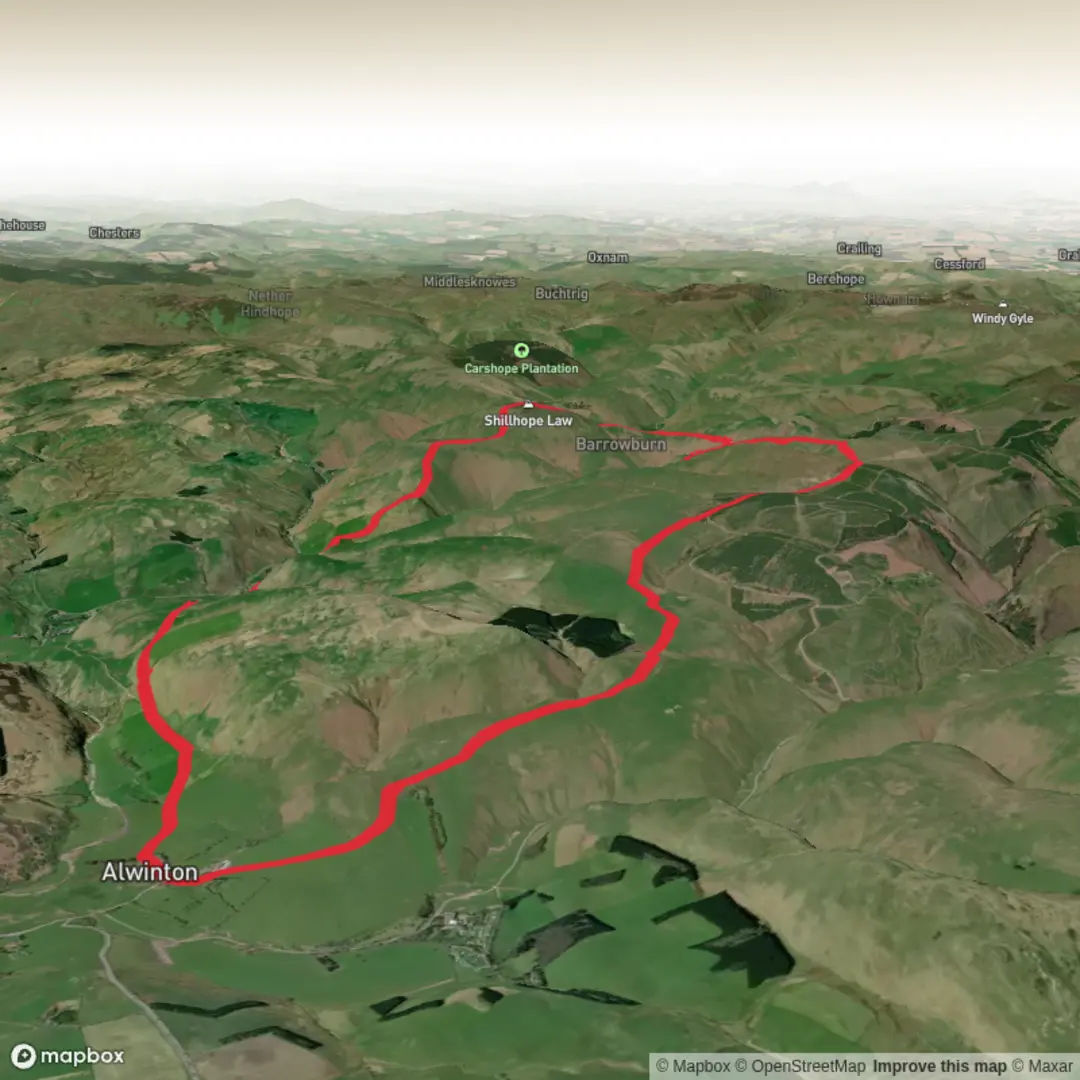
This 18 km / 11.2 mile loop in the southern Cheviots gives a fine mix of broad upland views, old hill tracks, open moorland, and a steady but manageable amount of climbing. With around 600 m / 1,970 ft of ascent, it sits well in the medium category: long enough to feel like a full hill day, but without the sustained severity of the highest Cheviot outings. The route is generally associated with the Harbottle–Alwinton side of Northumberland National Park, with the most practical access being from the Upper Coquetdale area near Alwinton, Northumberland, a small village on the B6341 near the River Coquet. Shillhope Law itself lies in the southern Cheviots, and the surrounding landscape falls within a notably wild part of the national park. (en.wikipedia.org)
Expect a route that begins on lower ground with easier walking before building into more exposed hill terrain. Early sections are often defined by estate tracks, grassy paths, or old drove-like lines, then the day opens out onto rougher upland ground where the sense of space becomes one of the walk’s main rewards. The climb onto Saughy Hill and onward toward Shillhope Law brings increasingly wide views over the Coquet valley, the Harbottle Hills, and deeper into the Cheviot massif. On a clear day, this is the kind of country where the skyline seems to keep unfolding as height is gained. (hiiker.app)
Terrain and what to expect
Although the distance is moderate, the route should not be underestimated. The 600 m / 1,970 ft of ascent is usually spread across a series of climbs rather than one single pull, so the day can feel longer than the raw numbers suggest. Underfoot, hikers should be prepared for a combination of firm tracks, cropped grass, heather moor, and potentially wet or peaty patches, especially after rain. In poor visibility, the open hill sections can feel quite featureless, so careful route-finding matters. If using navigation, HiiKER is the best fit for checking the line of the loop and monitoring progress on the more open sections.
The higher ground is exposed to wind, mist, and fast-changing weather. Even in fair conditions lower down, the tops can be markedly colder. Waterproofs, spare warm layers, and footwear that can cope with boggy ground are sensible year-round. Because this is a relatively remote part of Northumberland National Park, there are fewer easy escape options than on lower-level countryside walks. (hiiker.app)
Landmarks, landscape, and character
The defining landmark of the walk is Shillhope Law, one of the better-known hills in this part of the southern Cheviots. Its rounded profile is characteristic of the area: not craggy in the dramatic Lake District sense, but broad, open, and deeply atmospheric. The appeal here is in the scale of the moorland and the feeling of distance from roads and settlements. Saughy Hill provides an excellent approach ridge or shoulder, helping the route build gradually toward the higher point rather than delivering all its drama at once. (en.wikipedia.org)
Nearby, the wider Harbottle and Coquetdale landscape adds extra interest. Harbottle is known for its historic setting within the national park, and the surrounding hills are part of a landscape shaped by grazing, old routeways, and centuries of border history. The area around Harbottle Crags and Harbottle Moors is especially valued for its upland habitats and scenic character. (northumberlandnationalpark.org.uk)
Nature and wildlife
This is a good walk for hikers who enjoy upland ecology as much as summit views. The moorland and rough grassland around Harbottle Moors support a range of notable species and habitats, including heath vegetation, flushes, and invertebrate-rich upland ground. In the broader area, Northumberland Wildlife Trust notes species such as emperor moth, large heath butterfly, and green hairstreak butterfly, while nearby waters and wetter ground can attract birds including teal, goosander, and little grebe. (nwt.org.uk)
On the hill, hikers are more likely to notice the classic signs of upland birdlife: meadow pipits, skylarks in season, and raptors if conditions are favourable. Heather, bilberry, rough grasses, and bog plants all contribute to the texture of the route. Late summer can be especially attractive when the moorland colour deepens, though that can also coincide with drier but still uneven ground. Because this is open habitat, it is worth moving carefully and keeping noise low if hoping to spot wildlife.
Surfaces
Unknown
Unpaved
Paved
Comments and Reviews
User comments, reviews and discussions about the Saughy Hill and Shillhope Law Loop, England.
average rating out of 5
0 rating(s)
