Download
Preview
Add to list
More
8.0 km
~3 hrs 9 min
932 m
Out and Back
“A fierce, pathless Highland climb above Loch Etive rewards confident hikers with thrilling slab-edge drama.”
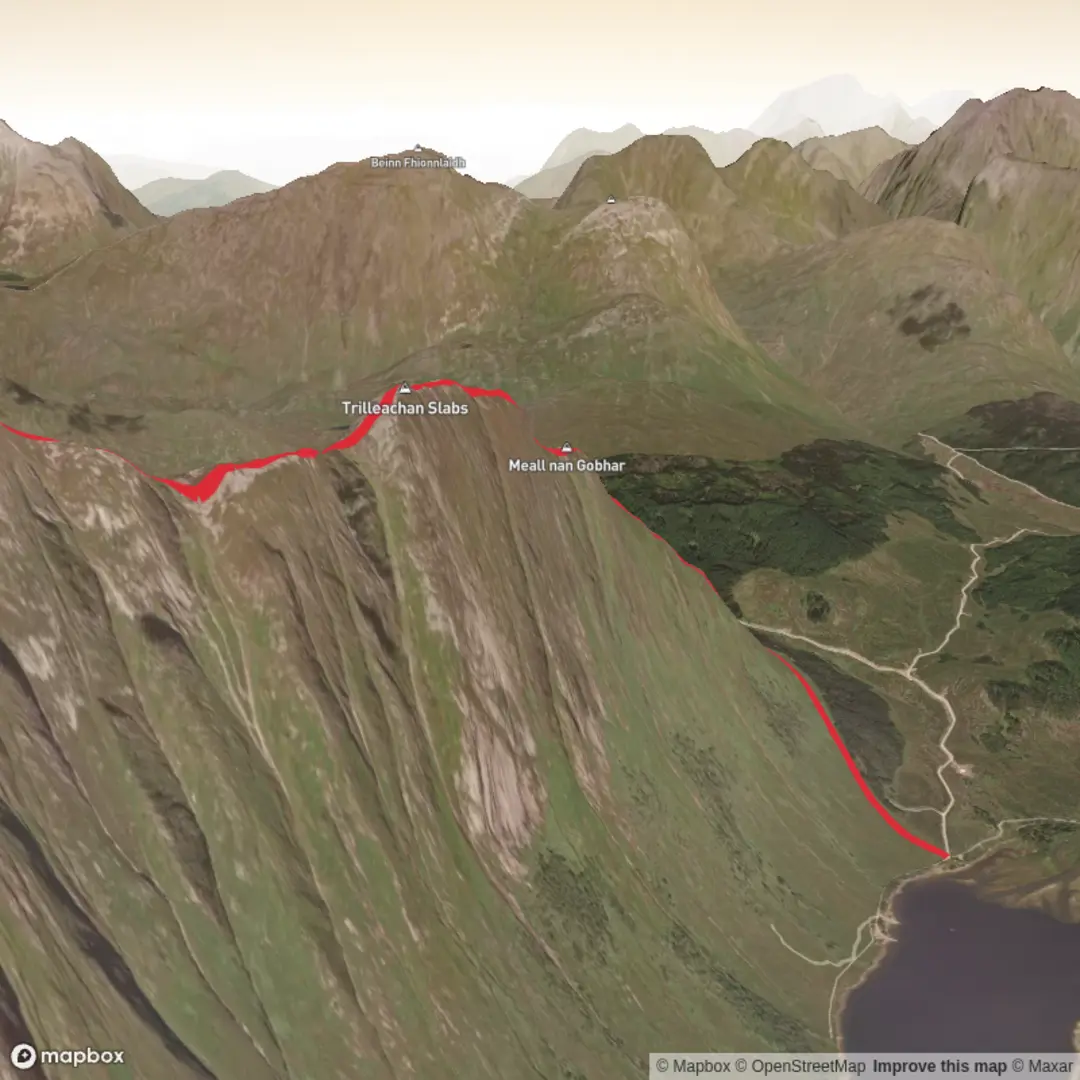
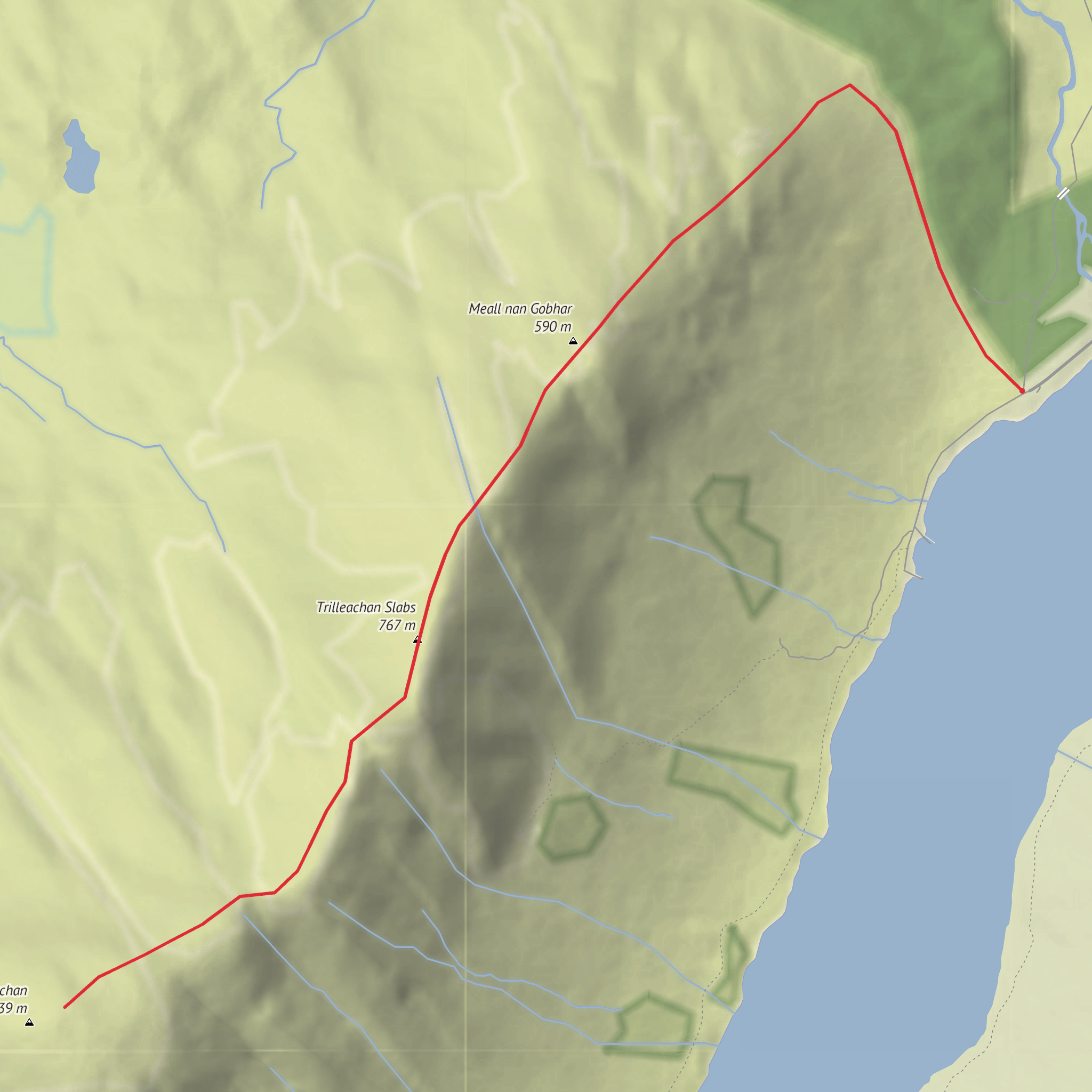
This is a short but very serious mountain outing above Loch Etive and Glen Etive in the western Highlands, linking Meall nan Gobhar, the edge of the Trilleachan Slabs, and Beinn Trilleachan. Although the round is only about 8 km / 5 miles, the climb is steep and sustained, with roughly 900 m / 2,950 ft of ascent packed into a relatively small distance. The “Extra Difficult” rating is justified by the combination of pathless ground, very steep grassy and rocky slopes, exposure near the slabs, and the need for confident route-finding in poor visibility. Beinn Trilleachan itself rises to about 840 m / 2,756 ft and is well known for the vast granite sweep of the Trilleachan or Etive Slabs above the loch. (walkhighlands.co.uk)
The usual start is at the road end and parking area at the head of Glen Etive, near Glen Etive House / Invercharnan, which is the nearest clear landmark for the hike head. From there, the route heads onto steep hillside ground rather than following a long established mountain path. Recent local reporting indicates that parking management in Glen Etive has become more formal, with Highland Council approving parking charges at Glen Etive road-end locations in May 2026, so it is worth checking current arrangements before setting out. (tristandkez.com)
By car, the simplest approach is from the A82 at Kingshouse, turning onto the single-track Glen Etive road and following it south-west to the road end near Glen Etive House. The drive is scenic but slow, with passing places and heavy visitor traffic in good weather. By public transport, the most practical option is usually to travel to Glencoe on the A82 using Scottish Citylink services, then arrange a taxi for the Glen Etive road, as regular public transport does not run deep into the glen. Another possibility is reaching Taynuilt by rail on the Oban branch, but that leaves a much longer onward road journey to the start. (bustimes.org)
The ascent
The route begins innocuously enough, but the character changes quickly. After leaving the roadside, the climb onto Meall nan Gobhar is direct and steep, gaining height rapidly above Loch Etive. Early on, expect rough grass, wet ground after rain, and intermittent traces of trods rather than a dependable built path. In dry weather the ascent is strenuous; in wet weather it can become slippery and awkward, especially where the hillside steepens and the ground mixes grass, heather, and rock. Around halfway through the climb, the views begin to open dramatically across the loch toward the larger mountains opposite, and the sense of exposure increases as the terrain steepens above the water. Sources describing the route note that Meall nan Gobhar itself is not especially distinct on the ground, so many walkers pass over it almost without realizing they have reached the top of the first rise. (outdooractive.com)
From the broad shoulder of Meall nan Gobhar, the route continues toward the upper edge of the Trilleachan Slabs. This is one of the most striking sections of the day. The slabs are famous in British climbing for their huge expanse of friction climbing on clean granite, and from above they form a dramatic architectural feature dropping toward Loch Etive. For walkers, this is not a place to drift casually toward the edge in mist, wind, or rain. The rock can be treacherous when wet, and the margins of the slabs are serious terrain. If cloud is down, careful navigation with HiiKER is especially important to avoid wandering onto steep ground. (rockfax.digital)
Beyond the slabs, the final rise to Beinn Trilleachan is comparatively straightforward in navigation terms, though still steep in places. The summit area is more open and rounded than the dramatic lower crags suggest, and on a clear day the panorama is exceptional: Loch Etive stretching away below, the mountains of Glen Coe to the north, and the wider West Highland massif unfolding in every direction. The return is usually made by retracing the ascent line, which means the steep ground has to be descended with care. On tired legs, the descent can feel more demanding than the climb, especially if the grass is greasy or if rain has moved in. �
Comments and Reviews
User comments, reviews and discussions about the Meall nan Gobhar, Trilleachan Slabs and Beinn Trilleachan, Scotland.
average rating out of 5
0 rating(s)