Download
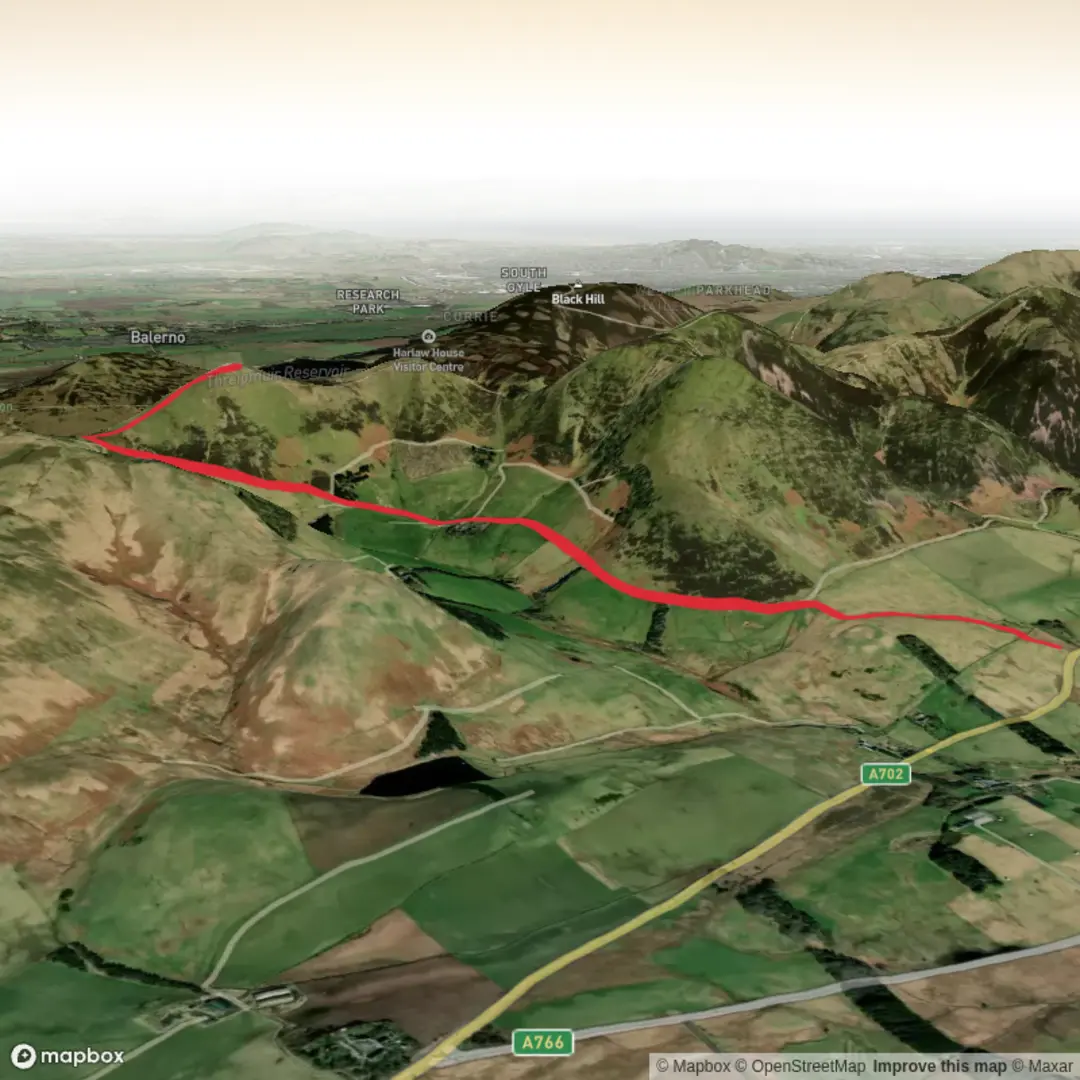
3D Flyover
Add to list
More
6.3 km
~1 hrs 42 min
267 m
Out and Back
“West Kip packs a steep, wind-brushed climb, sweeping Pentland views, and a touch of old hill history.”
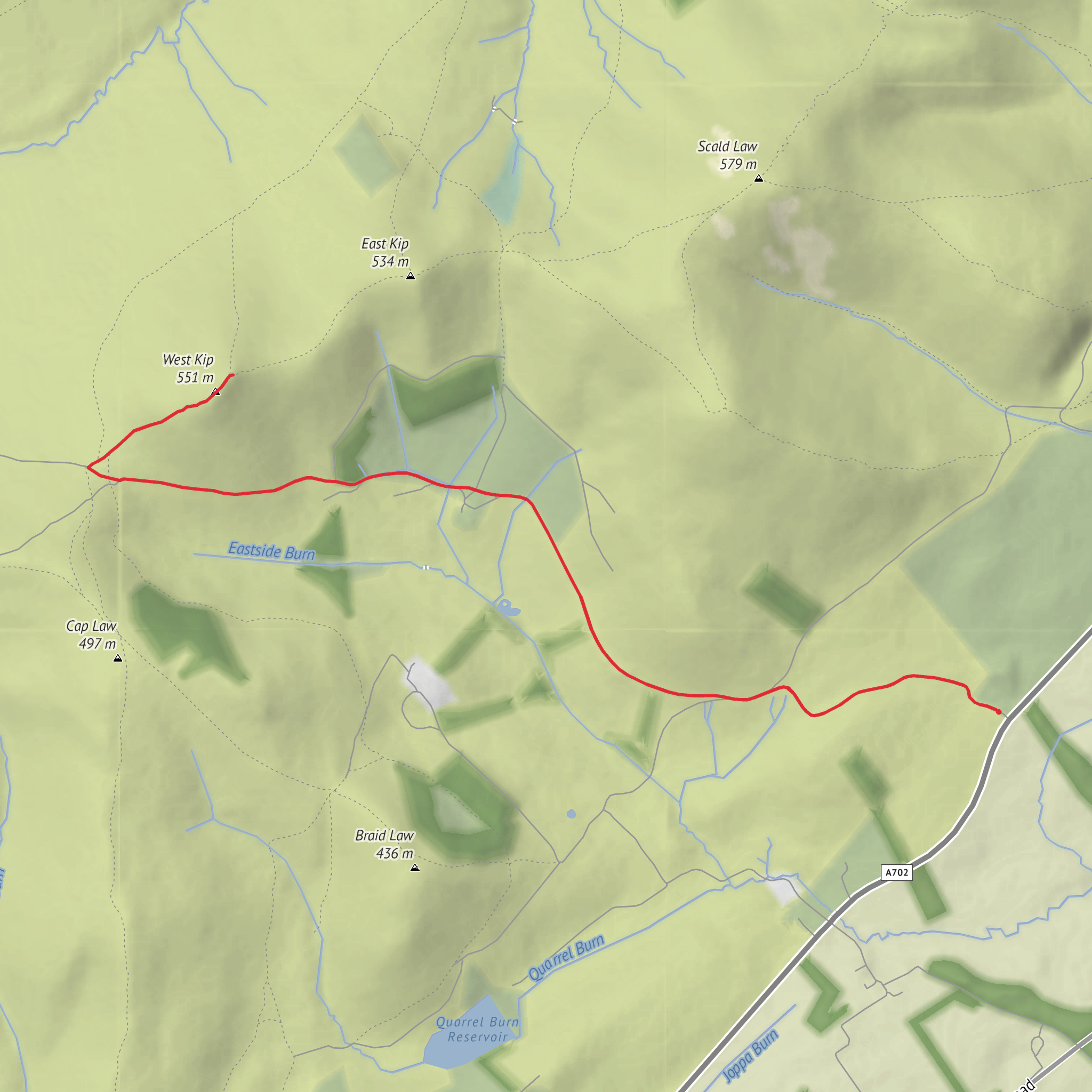
This medium-rated outing to West Kip sits in the Pentland Hills Regional Park southwest of Edinburgh, and a practical version of the walk is usually done from the Nine Mile Burn car park, EH26 9LZ, near the hamlet of Nine Mile Burn on the A702. That start point is given at approximately 55.8055, -3.3143, which corresponds to the roadside parking area just outside the village. A typical circuit here comes out at roughly 6 km / 3.7 miles with about 300 m / 985 ft of ascent, though exact totals vary depending on whether you add East Kip or take a wider return line. (ramblers.org.uk)
The character of the walk is classic Pentlands: open moorland, grassy hill paths, broad views, and one notably steep pull onto the summit cone. West Kip itself rises to about 551 m / 1,808 ft and is one of the most distinctive hills in the range, with a sharper, more pointed profile than many of its neighbours. Even on a relatively short route, the climb can feel punchy because much of the elevation is gained in a concentrated section rather than spread evenly across the day. (walkhighlands.co.uk)
For drivers, the easiest access is usually via the A702 to Nine Mile Burn, then into the small parking area used for Pentland walks. If you are relying on public transport, Nine Mile Burn is served by buses including the 101, 101A and 102, making it one of the more straightforward western Pentlands starts to reach without a car; as always, check current timetables before setting out. (bustimes.org)
What the route feels like
From the western side, the early part of the walk is often gentle enough to let you settle in before the main climb. Tracks and grassy paths lead across open ground toward the col between Cap Law and West Kip, and from there the route steepens decisively. On a dry day the ascent is straightforward but sustained; in wet or windy weather it can feel much more serious, especially because the upper slopes are exposed and there is little shelter. Walkers should expect a mix of short turf, worn hill path, and occasionally muddy or slick sections where boots have polished the line. (walkhighlands.co.uk)
The summit rewards the effort with wide views over Lothian, the surrounding Pentland ridge, and the rolling farmland beyond. If your version includes East Kip, the ridge section adds a pleasing up-and-down traverse and makes the outing feel more like a proper hill circuit than a simple out-and-back. The descent can be just as important as the climb here: steep grass can be slippery after rain, frost, or strong dew, so trekking poles can be useful for some hikers. For navigation, this is the kind of hill where low cloud can flatten the landscape and make junctions less obvious than they seem in clear weather, so having the route loaded in HiiKER is sensible. (walkhighlands.co.uk)
Landmarks, landscape and wildlife
One of the notable historic features associated with this side of West Kip is the Font Stone, an old carved stone on the Monks Rig line of approach. It is a reminder that these hills are not just scenic uplands but a long-used cultural landscape threaded with old routes, boundary features and archaeological traces. The wider Pentlands also contain forts, cairns and other historic remains, reflecting human use of the area over many centuries. (ramblers.org.uk)
The surrounding landscape is a blend of rolling hills, upland heather moorland, small pockets of woodland, and reservoirs. Sheep farming remains the dominant land use, and parts of the moor are also managed for shooting, so it is normal to encounter grazing animals, estate tracks, and managed heather. That combination gives the walk its distinctly open, pastoral-upland feel. (pentlandhills.org)
Wildlife can be one of the highlights if you move quietly and keep an eye on the moor. The Pentland Hills species records include birds such as
Surfaces
Gravel
Dirt
Unknown
Comments and Reviews
User comments, reviews and discussions about the West Kip, Scotland.
average rating out of 5
0 rating(s)