Download
Preview
Add to list
More
2.9 km
~59 min
252 m
Out and Back
“A steep Speyside burst, where slippery slopes and sweeping skies turn a brief climb into drama.”
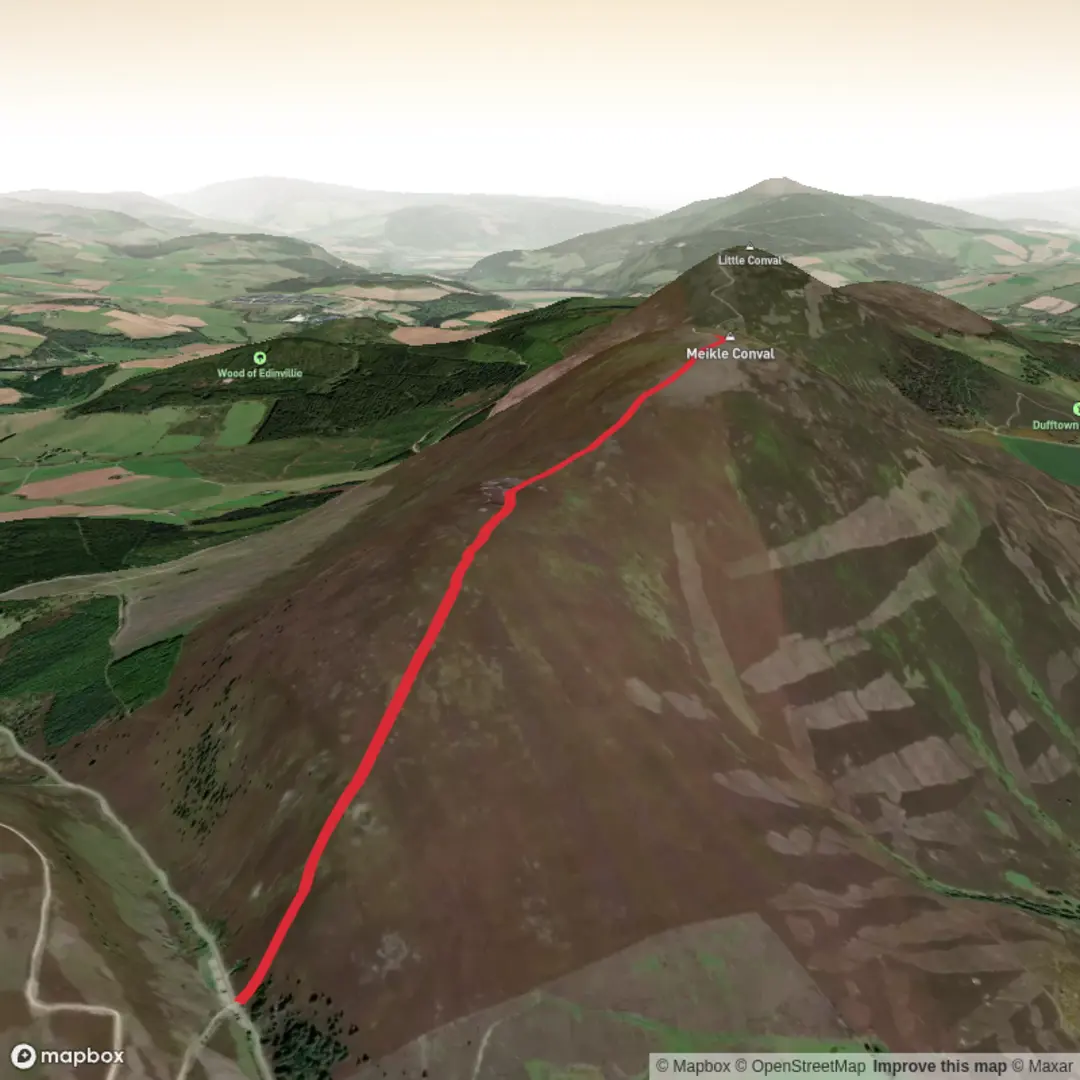
This is a short but punchy hill walk of about 3 km / 1.9 miles with roughly 300 m / 985 ft of ascent, so although the distance looks modest on paper, it feels much more strenuous than many longer outings. With an estimated Difficult rating, the main challenge comes from the steep climbing and the likelihood of uneven, sometimes wet ground rather than from route length. Expect a compact outing that gains height quickly, rewards effort with broad views, and demands steady footing on the way both up and down.
The route lies in the Meikle Conval area near Dufftown, Moray, Scotland, with the usual access point associated with the hill being close to the Conval Hills / Dufftown area, a well-known landmark in Speyside. If you are planning from coordinates, the nearest practical destination to look for is generally Dufftown town centre or the Conval Hills access area just outside Dufftown, rather than relying on a remote pin alone.
Getting to the start is usually simplest by car. Dufftown is reached by road from nearby Speyside communities and larger hubs such as Elgin, Keith, or Huntly, and from there local minor roads lead toward the foot of the Conval hills. Parking is often limited in upland access areas, so it is worth checking your exact start point on HiiKER before setting out and arriving with a backup parking option in mind. By public transport, the most realistic approach is typically to travel by bus to Dufftown, then continue on foot or by local taxi to the trailhead area, since direct public transport to the hill access points themselves is usually limited.
The character of the walk changes quickly. It often begins on more manageable ground—track, path, or grassy access terrain—before steepening into a more sustained climb. Because the route is an out-and-back, the same steep sections that test you on the ascent will need care on the descent, especially after rain when grass, mud, and exposed soil can become slippery. Even over only 3 km / 1.9 miles, the gradient can make this feel like a serious short mountain outing rather than a casual stroll.
Terrain and what to expect
The lower section is likely to pass through or beside rough pasture, moorland edge, or access land typical of the Speyside uplands. As height is gained, the route becomes more open and exposed. The climb toward Meikle Conval is the defining feature: short, direct, and energy-sapping. Hikers should be prepared for:
- Steep gradients over a relatively short distance
- Uneven footing, including loose stones, muddy patches, and worn path sections
- Exposure to wind once above the lower sheltered ground
- A descent that can be harder on knees and balance than expected
Because the route is brief, some walkers underestimate it and bring too little water or wear unsuitable footwear. Sturdy boots or trail shoes with strong grip are a better choice than casual trainers, especially in damp conditions. Trekking poles can also help on the return leg.
Navigation is usually more straightforward in clear weather on a short out-and-back, but hill fog can reduce visibility quickly on open ground. For planning and live route guidance, use HiiKER and check the line of ascent carefully before setting off. On a hill like this, a short route can still become confusing if multiple faint paths, livestock tracks, or eroded lines branch across the slope.
Views, landscape, and natural features
One of the biggest rewards of this walk is how quickly it opens out into classic Speyside hill scenery. As you climb, views begin to stretch across the surrounding farmland, wooded patches, and rolling uplands around Dufftown. On a clear day, the elevated position gives a strong sense of the layered landscape that defines this part of Moray: agricultural low ground below, rounded hills beyond, and a patchwork of forest and open moor.
The Conval hills are known for their prominence above the surrounding area, so even a relatively short ascent can feel surprisingly expansive. The summit area and upper slopes often have that broad, airy quality typical of northeastern Scottish hills—open sky, wind exposure, and long sightlines in multiple directions.
Vegetation is likely to include heather, rough grasses, bracken in season, and upland shrubs, with wetter patches supporting mosses and bog-loving plants. In late summer and early autumn, the moorland tones can be especially striking, while spring can bring fresher greens lower down.
Wildlife is typical of the Scottish uplands and moorland fringe. Hikers may spot or hear:
- Red grouse in heather areas
- Skylarks and other upland songbirds in open ground
- Buzzards or kestrels overhead
- Deer, especially in quieter periods
- Seasonal insects in warmer months, including midges when conditions are still and damp
Livestock may also be present on lower ground, so dogs should be managed responsibly and local access guidance followed.
Historical significance of the area
The wider Dufftown and Speyside region has deep historical character. Dufftown itself is strongly associated with the whisky heritage of Speyside and sits in a landscape shaped by long agricultural use, estate history, and upland grazing. The surrounding hills, including the Convals, have long served as natural landmarks above settlement and route corridors through the region.
This part of northeastern Scotland also carries the imprint of older Highland and rural history: scattered farmsteads, estate boundaries, old drove and access routes, and centuries of land use tied to grazing, game management, and small-scale agriculture. Even where the trail itself feels purely natural, the landscape has been shaped over generations by people
Surfaces
Ground
Unknown
Comments and Reviews
User comments, reviews and discussions about the Meikle Conval Out and Back, Scotland.
average rating out of 5
0 rating(s)