
Download
3D Flyover
Add to list
More
82.2 km
4 days
2231 m
Multi-Day
“From Romanesque villages to glacial lakes and steamy spas, this Pyrenean traverse rewards prepared hikers.”
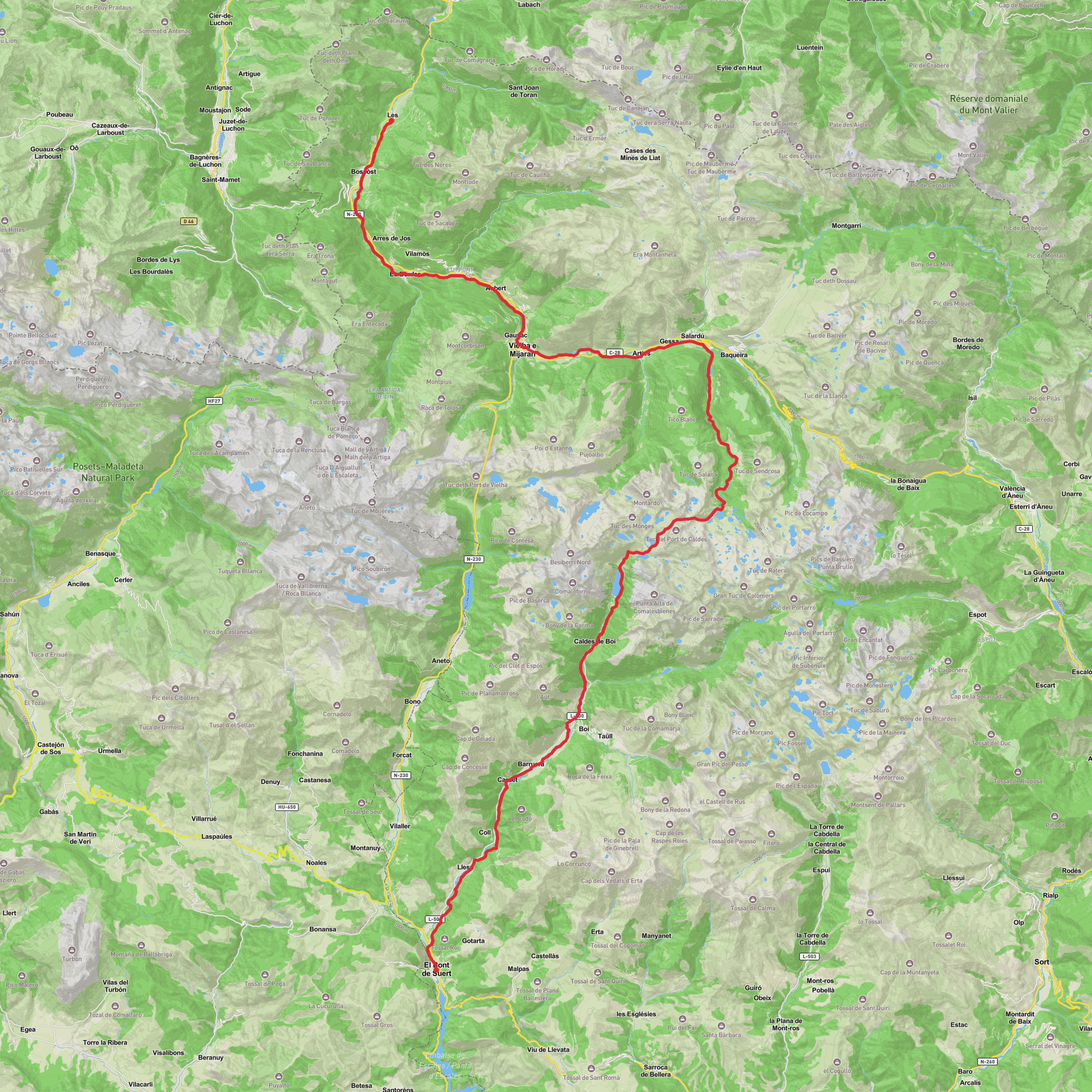
This is a point-to-point, hut-and-village style traverse through the central Pyrenees, linking a chain of historic spa settlements and high mountain basins between El Pont de Suert and the lower Val d’Aran (typically finishing around Bossòst, near the French border). Expect roughly 82 km / 51 mi with about 2,300 m / 7,550 ft of total ascent (many guides clock it a bit longer, closer to the mid‑80 km range, depending on variants). (outdooractive.com)
You’ll move from river valleys and Romanesque villages into the granite-and-lake heart of Aigüestortes i Estany de Sant Maurici National Park, then descend into the Aran Valley along the Garonne/Garona watershed—so the feel changes dramatically day to day: shaded forest tracks and old lanes early on, a single big alpine stage in the middle, then gentler valley walking to the finish. (outdooractive.com)
Getting to the start (El Pont de Suert) + logistics
Start location (nearest significant landmark): the route is commonly started in El Pont de Suert (Alta Ribagorça, Lleida)—a small town on the Noguera Ribagorçana corridor and a practical gateway to the Boí Valley. (hiking-trails.com)
By public transport: the most straightforward approach is usually via Barcelona, then onward by coach/bus to El Pont de Suert (services run multiple times per day depending on season/operator). Check current timetables and stops before committing, as mountain services can be seasonal. (rome2rio.com)
By car: driving is simple and flexible for a point-to-point hike—plan either (1) a shuttle between El Pont de Suert and the finish area (Bossòst/Vielha), or (2) leave a car at one end and use a taxi/bus transfer to the other. Roads into the valleys are good, but allow extra time for weekend traffic and weather.
Navigation: download the full line and any alternates in HiiKER before you arrive, and keep an offline copy—mobile coverage becomes unreliable once you’re deep in the national park basins.
What the route feels like (terrain, gradients, and daily rhythm)
Most hikers break Via Calda into 4–5 stages. A common 5-day split looks like:
- Day 1: El Pont de Suert → Boí, ~18–19 km / 11–12 mi, ~+580 m / +1,900 ft
- Day 2: Boí → Caldes de Boí, ~6–7 km / 4 mi, ~+280 m / +920 ft (often extended with a park variant)
- Day 3: Caldes de Boí → Banhs de Tredòs, the “big mountain day” through high basins and lakes (distance varies by variant)
- Day 4: Banhs de Tredòs → Vielha, ~20 km / 12 mi, mostly descending/rolling valley travel
- Day 5: Vielha → Bossòst, ~20 km / 12 mi, gentle gradients along the Garona corridor (outdooractive.com)
Underfoot, expect a mix of: - Village lanes and forest tracks (often fast, sometimes hard on feet if paved) - Rockier mountain paths in the national park (slower, more careful foot placement) - Stream crossings and wet ground in “aigüestortes” terrain (literally “twisting waters”), especially after rain or snowmelt (en.wikipedia.org)
Even with a “Medium” overall rating, the seriousness comes from the combination of multi-day distance, one high, committing stage, and rapid weather shifts typical of the Pyrenees.
Landmarks, thermal culture, and historical significance
A defining theme is the long tradition of thermal bathing in these valleys. The route is designed to connect major spa points such as Caldes de Boí and **Banhs
Surfaces
Unknown
Ground
Asphalt
Unpaved
Paved
Concrete
Dirt
Wood
Cobblestone
Comments and Reviews
User comments, reviews and discussions about the Via Calda, Spain.
average rating out of 5
0 rating(s)
