Download
3D Flyover
Add to list
More
9.4 km
~2 hrs 17 min
240 m
Loop
“A rolling loop to Cerro del Cinto—scrubby hills, breezy viewpoints, and gravelly descents to savour.”
I’m missing a few key pieces needed to write this accurately (especially the start location). If you paste the lon/lat for the trailhead (or share the map), I’ll convert it to the nearest known address/landmark and tailor directions, landmarks, and hazards precisely.
In the meantime, here’s a planning-ready description based on what you’ve provided for a ~9 km (5.6 mi) loop with ~200 m (656 ft) of gain, rated Medium—written so you can prepare, with distances you can sanity-check once you confirm the trailhead.
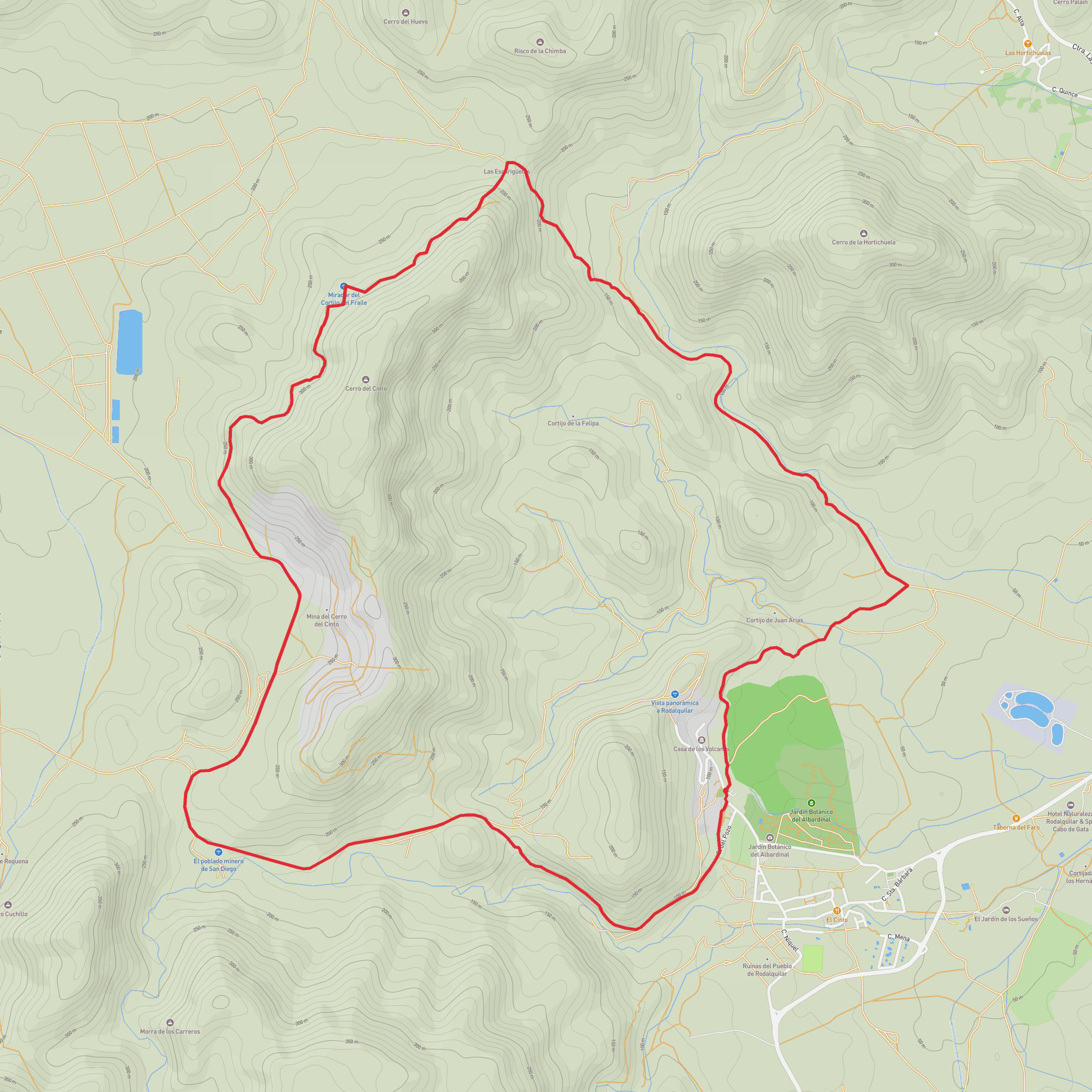
You’ll be on a compact loop that mixes easy-going track with short, steeper pushes as you link the Las Escarigueelas area with the rounded high point of Cerro del Cinto. Expect a “rolling” feel rather than one long climb: small rises and dips add up to the ~200 m total, with the most sustained effort typically occurring as you leave the lower paths and commit to the hillside.
Getting to the start (car + public transport)
By car: Plan for a small roadside pull-in or informal parking near the nearest village access point. In this kind of terrain, parking is often limited and surfaces can be rough—arrive early on weekends and avoid blocking gates or farm access.
By public transport: If there’s a bus stop in the nearest village, the usual pattern is: regional bus to the closest town, then a local bus/taxi to the village edge, finishing with a short walk to the trailhead.
If you tell me the nearest town/village name (or provide coordinates), I’ll give you the most realistic public-transport approach and the likely “last safe drop-off point.”
What the route feels like underfoot
From the trailhead, the first 1–2 km (0.6–1.2 mi) are usually the warm-up: wider track or a well-used path that lets you settle into a rhythm. Grades are gentle here, and it’s a good place to check footwear comfort, adjust layers, and open HiiKER to confirm you’re aligned with the intended loop direction.
As you begin to arc toward Cerro del Cinto, the path typically narrows and the surface becomes more variable—think firmer dirt with loose stone patches. Over the next 2–4 km (1.2–2.5 mi) you’ll likely gain most of the elevation, roughly 150–200 m (490–656 ft) depending on the exact line. The climb is “medium” because it’s not technically hard, but it can feel punchy in short ramps—especially if the ground is dry and gravelly.
Near the higher ground, you’ll often get the best open views. Even modest hills in this landscape can provide wide panoramas over ridgelines, cultivated valleys, and scattered rural buildings. If there’s a true summit point or shoulder on Cerro del Cinto, it’s a natural pause spot—wind exposure is common, so a light shell can be useful even on warm days.
The return side of the loop generally trends downhill over 3–4 km (1.9–2.5 mi). Descents here can be the most slippery part of the day: small stones act like ball bearings on hardpack. Trekking poles help, but if you’re traveling light, focus on shorter steps and controlled foot placement. The final 1 km (0.6 mi) usually eases back onto broader track as you re-approach the start.
Navigation and “where people go wrong”
Loops like this are straightforward in clear weather, but there are a few classic confusion points: - Junction clusters: Farm tracks and maintenance roads can create multiple near-identical turnoffs. Use HiiKER at each major junction rather than trying to “feel” the right line. - Faint contouring paths: The traverse sections can fade where vegetation encroaches or where runoff has cut the tread. If the path becomes indistinct, stop and confirm on HiiKER before committing downhill (it’s easy to lose elevation the wrong way and have to climb back). - Shortcuts: You may see steep “direct” lines that look faster. They’re often erosion scars—looser, more slippery, and harder on knees.
Landmarks, landscape, and wildlife to watch for
You’re likely moving through a mosaic of scrub, open hillside, and managed rural land. Typical features to look for: - Dry-stone walls, terraces, or old boundary lines that hint at long-term agricultural use. - Seasonal drainage channels (even if dry) that can be rough underfoot and can funnel you off-route if you follow them unintentionally. - Ridgetop wind exposure near Cerro del Cinto—great for views, but it can chill you quickly when you stop.
Wildlife is usually subtle rather than dramatic: small birds, lizards, and signs of mammals (tracks/scat) are common. If the area includes grazing land, you may encounter livestock—give animals space, keep voices calm, and pass wide around herds. Ticks can be present in brushy sections; long socks and a post-hike check are smart.
Hazards and conditions (what to pack for a “Medium” 9 km loop)
- Heat and sun: With only ~9 km (5.6 mi), people underestimate water. In warm conditions, carry at least 1–1.5 L per person; more if there’s little shade.
- Loose rock on descents: Shoes with solid tread matter more than speed. Expect some ankle-rolling terrain.
- Wind on higher ground: A light layer can make breaks comfortable.
- After rain:
Surfaces
Gravel
Unknown
Ground
Comments and Reviews
User comments, reviews and discussions about the Las Escarigueelas and Cerro del Cinto Loop, Spain.
average rating out of 5
0 rating(s)