
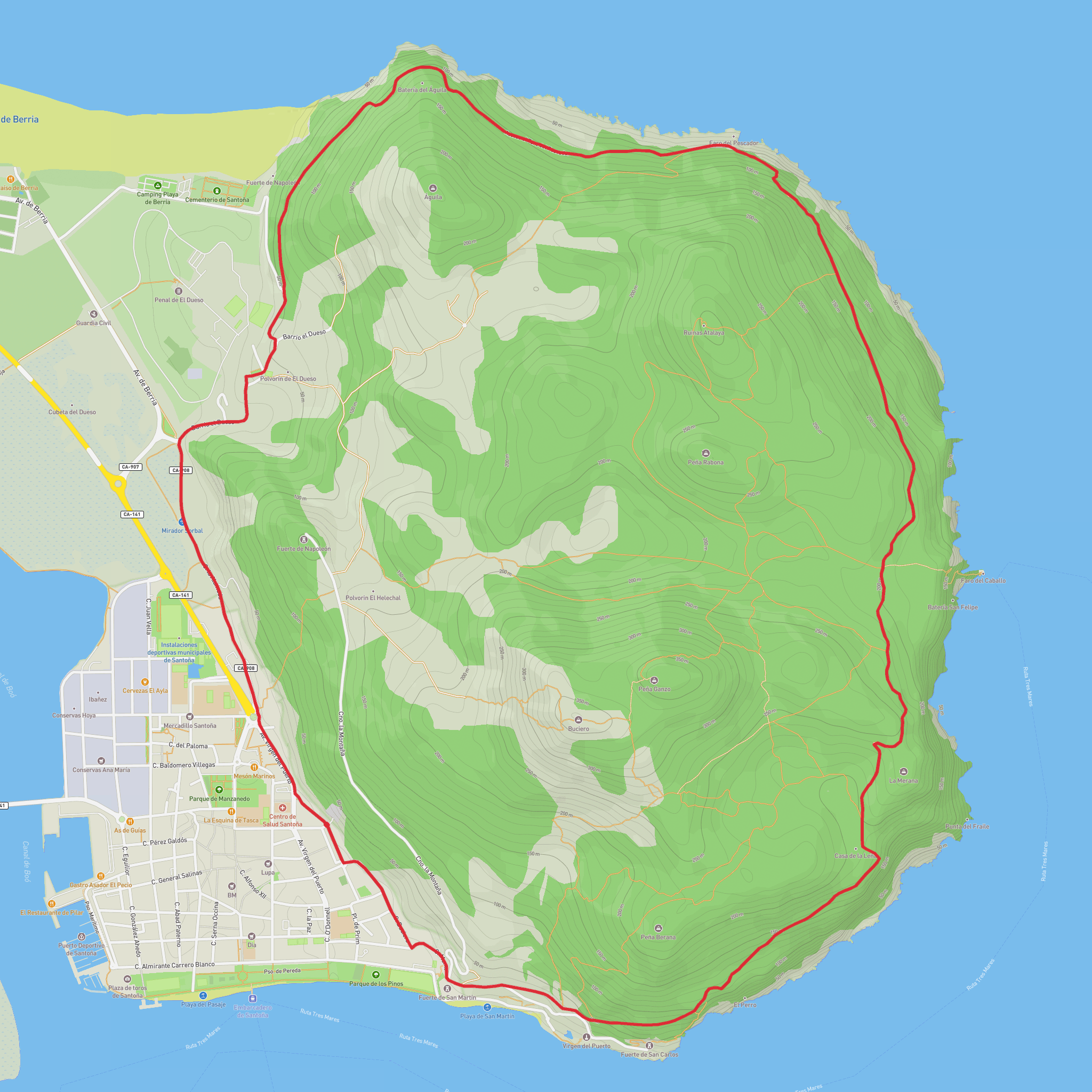
Faro del Caballo, Faro del Pescador, Punta de Pescador and Punta del Aguila Loop
Download
3D Flyover
Add to list
More
9.4 km
~2 hrs 19 min
272 m
Loop
“A sea-salted headland loop past four lighthouses, where punchy rises earn wind-whipped horizons.”
This medium loop links a string of dramatic headlands and four lighthouses/viewpoints—Faro del Caballo, Faro del Pescador, Punta de Pescador, and Punta del Águila—on a rugged, sea-battered coastline. Expect about 9 km (5.6 mi) with roughly 300 m (985 ft) of total climbing, mostly delivered in short, punchy rises and dips as the path rolls over points and small coves. Underfoot you’ll typically see a mix of compacted dirt, rocky tread, and exposed coastal stone; after rain or sea mist, the rock can be slick and the soil can turn greasy in shaded pockets.
Getting to the start (car + public transport)
Because “near” and the exact coordinates weren’t included, the most reliable way to pinpoint the trailhead is to open the route in HiiKER and use its start-point navigation. Once you share the lon/lat (or a HiiKER link), I can translate it to the nearest recognizable address or landmark (for example, a lighthouse parking area, a coastal road pull-off, or a named mirador).
In general for lighthouse-and-headland loops like this: - By car: You’ll usually start from a lighthouse access road or a coastal viewpoint parking area. Arrive early if it’s a popular scenic drive—spaces can fill quickly on weekends and clear-weather days. - By public transport: Coastal trailheads are often served by a regional bus to the nearest town, then a taxi/rideshare or a longer walk to the actual lighthouse road. If you tell me the nearest town you’re staying in (or the country/region), I can outline the most realistic transit approach.
From the start, the route typically wastes no time: you’ll either climb gently away from the access road to gain the first headland, or drop toward the shoreline to pick up the coastal path. Early on, take a moment to confirm your direction in HiiKER—coastal networks often have multiple faint side paths to viewpoints that can lure you off-route.
You’ll likely reach the first major landmark within the first 1–2 km (0.6–1.2 mi). The “Faro” points are usually positioned for maximum visibility, so expect open horizons, strong wind exposure, and very little shade. If the route approaches Faro del Caballo via a descent, watch for loose gravel on steeper pitches; if it approaches via a climb, it’s often a steady grind that can feel harder than the numbers suggest because of wind resistance.
Headlands, lighthouses, and the character of the terrain
As you continue, the loop’s rhythm becomes clear: short climbs (20–80 m / 65–260 ft at a time) to each point, then descents into saddles or small inlets. Over the full 300 m (985 ft), the elevation gain is rarely one continuous climb—more often it’s cumulative “coastal rollercoaster” effort.
Between ~2–6 km (1.2–3.7 mi) you’ll usually string together the most scenic sequence: - Faro del Pescador tends to sit on a prominent spur with wide-angle views along the coast. These lighthouse areas can have low walls, platforms, or old service tracks—great for orientation, but be cautious near edges where the ground can be undercut. - Punta de Pescador and Punta del Águila are classic “point” terrain: narrow promontories, wind-scoured vegetation, and abrupt drop-offs. The trail may narrow here, and in places it can run close to cliff lines. Give yourself extra space if gusts are strong, and avoid stepping onto tempting “shortcut” social trails that cut corners—those often crumble fastest.
If the loop includes any sections on old service roads or wider tracks near the lighthouses, they can feel easy—use them to eat, hydrate, and check HiiKER for the next singletrack turn. Many hikers miss junctions right after a viewpoint because they’re focused on the scenery.
Nature and wildlife to look for
Coastal headland routes like this are usually defined by salt-tolerant scrub, hardy grasses, and seasonal wildflowers in sheltered pockets. You may see: - Seabirds riding the wind along the cliffs (gulls, cormorants, and other coastal species depending on region). Watch for birds nesting on ledges—keep voices low and stay on the main tread. - Raptors using updrafts over the points (the “Águila” name often reflects the presence of eagles or hawk-like silhouettes in the area, though exact species vary by coastline). - Marine life visible from higher points on calm days—dark shapes in the water, baitfish activity, or surf patterns around reefs.
Ticks and mosquitoes depend heavily on the specific region and season; if the route passes through taller grass between headlands, long socks and a quick post-hike check are smart.
Historical and cultural context
Lighthouses along a loop like this are rarely just scenic props—they’re part of a coastal safety network tied to fishing grounds, shipping lanes, and hazardous headlands. The clustering of multiple “Faro” landmarks suggests a coastline where navigation demanded clear reference points, especially in fog, storms, or strong currents. In many regions, lighthouse service tracks and maintenance routes later became the backbone of today’s hiking paths, which is why you may alternate between narrow footpath and more engineered access sections.
Practical planning: time, water, and conditions
- Time estimate: Many hikers will take **3–
Surfaces
Unknown
Asphalt
Comments and Reviews
User comments, reviews and discussions about the Faro del Caballo, Faro del Pescador, Punta de Pescador and Punta del Aguila Loop, Spain.
average rating out of 5
0 rating(s)
