
Download
3D Flyover
Add to list
More
6.7 km
~1 hrs 46 min
262 m
Out and Back
“A strenuous Appalachian Trail detour unfolds from airy highlands to hushed forest and a thunderous waterfall reward.”
This out-and-back to Jones Falls is a rewarding Appalachian Trail side trip in the Roan Highlands area, combining open mountain walking, mixed forest, and a dramatic waterfall finish. The route is commonly described as about 10.6 miles / 17.1 km round trip with roughly 2,480 feet / 756 metres of elevation gain, so it is notably longer and steeper than the 7 km / 4.3 mile, 300 metre figure you provided. If you are planning from the shorter estimate, it is worth adjusting expectations before setting out. (theoutbound.com)
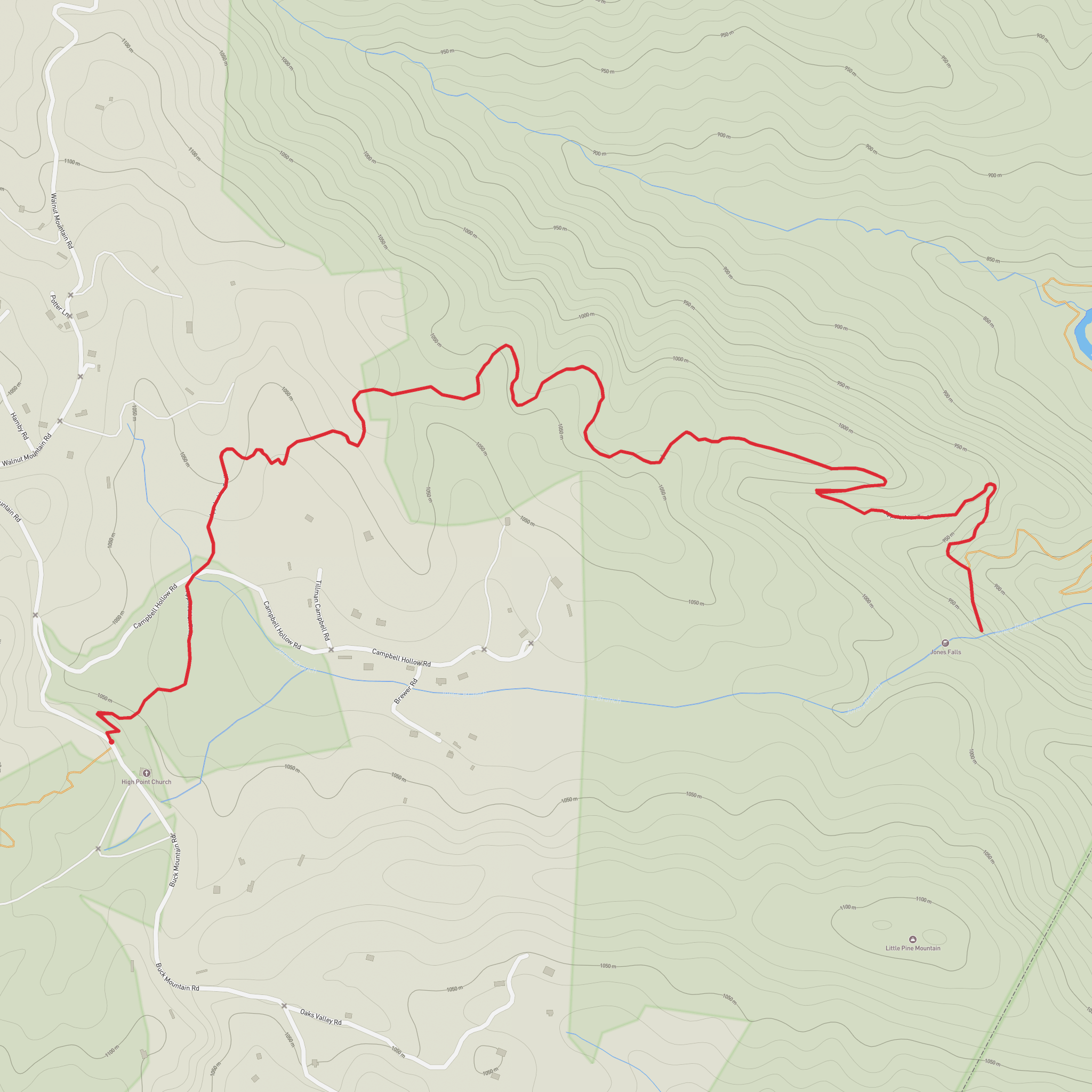
The hike begins at the Appalachian Trail crossing on US 19E near Roan Mountain, Tennessee, close to The Appalachian Station at 19E, 9367 US-19E, Roan Mountain, TN 37687, which is a useful nearby landmark for navigation and trip planning. From the road crossing, the white-blazed Appalachian Trail heads north and climbs steadily for about 3.1 miles / 5 km, gaining close to 1,000 feet / 305 metres through a mix of wooded trail and more open grassy stretches with broad views into the surrounding valleys. (theoutbound.com)
What the route feels like
The first half of the walk is the work. The grade is sustained rather than technical, and the “medium” rating makes sense for hikers who are comfortable with a half-day mountain outing, but it can feel harder in heat, mud, or if you are carrying extra water. After the initial climb, the trail drops briefly into a creek bed area, rises again to cross Buck Mountain Road and Campbell Hollow Road, then trends through an old pine nursery and more enclosed forest. The final approach is easier to miss if you are moving quickly: a wooden sign marks the short blue-blazed spur to Jones Falls, about 0.1 mile / 0.16 km off the AT. In wet seasons, you may hear the falls before you see them. (theoutbound.com)
Jones Falls itself is the payoff: a tall waterfall reported at nearly 100 feet / 30 metres, tucked just off the main Appalachian Trail corridor. Spring usually brings the strongest flow, while late summer and early autumn can be noticeably lower. Around the falls, expect slick rock, damp soil, and potentially hazardous footing, especially after rain or during freeze-thaw periods. Even when the main trail is straightforward, the waterfall area deserves slower, more deliberate movement. (theoutbound.com)
Landmarks, nature, and wildlife
One of the appealing things about this route is the contrast between exposed high-country scenery and sheltered woodland. Early on, the open meadows and grassy sections provide some of the best long-range views on the hike, with the Roan Highlands landscape spreading out around you. Farther in, the trail becomes more enclosed, passing through conifer stands and mature forest before dropping toward the falls. (theoutbound.com)
Wildlife is typical of the southern Appalachian highlands. Hikers should be alert for black bears, white-tailed deer, wild turkey, salamanders in damp areas, and a wide variety of songbirds. In warmer months, ticks and stinging insects are worth watching for, and in shoulder seasons the combination of wet leaves, roots, and shaded rock can be more of a hazard than the elevation itself. Because this is part of the Appalachian Trail corridor, it is also common to encounter backpackers during thru-hiking season. The best way to stay oriented is to track the white blazes and confirm the waterfall spur on HiiKER before you leave the trailhead. (theoutbound.com)
Historical significance of the area
This hike sits within one of the most storied sections of the Appalachian Trail. The AT was first conceived in 1921 and completed in 1937, and today it remains one of the most important long-distance footpaths in the United States, maintained through a partnership involving the National Park Service, the U.S. Forest Service, the Appalachian Trail Conservancy, state agencies, and volunteers. Walking even a short section like this places hikers on a route with deep conservation history and a long tradition of trail stewardship. (nps.gov)
The broader Roan Mountain and Roan Highlands region is also historically significant for its mountain communities, old road corridors, and long-standing use as a passage through the southern Appalachians. The nearby US 19E crossing is one of the classic access points for Appalachian Trail hikers moving through northeastern Tennessee, and the area around Roan Mountain has become a well-known support hub for section
Comments and Reviews
User comments, reviews and discussions about the Jones Falls via Appalachian Trail, Tennessee.
average rating out of 5
0 rating(s)