
Download
3D Flyover
Add to list
More
16.6 km
~4 hrs 34 min
753 m
Loop
“A rugged ridge-and-hollow ramble above Roaring Run—rocky climbs, airy pines, and rain-slowed creeks for confident hikers.”
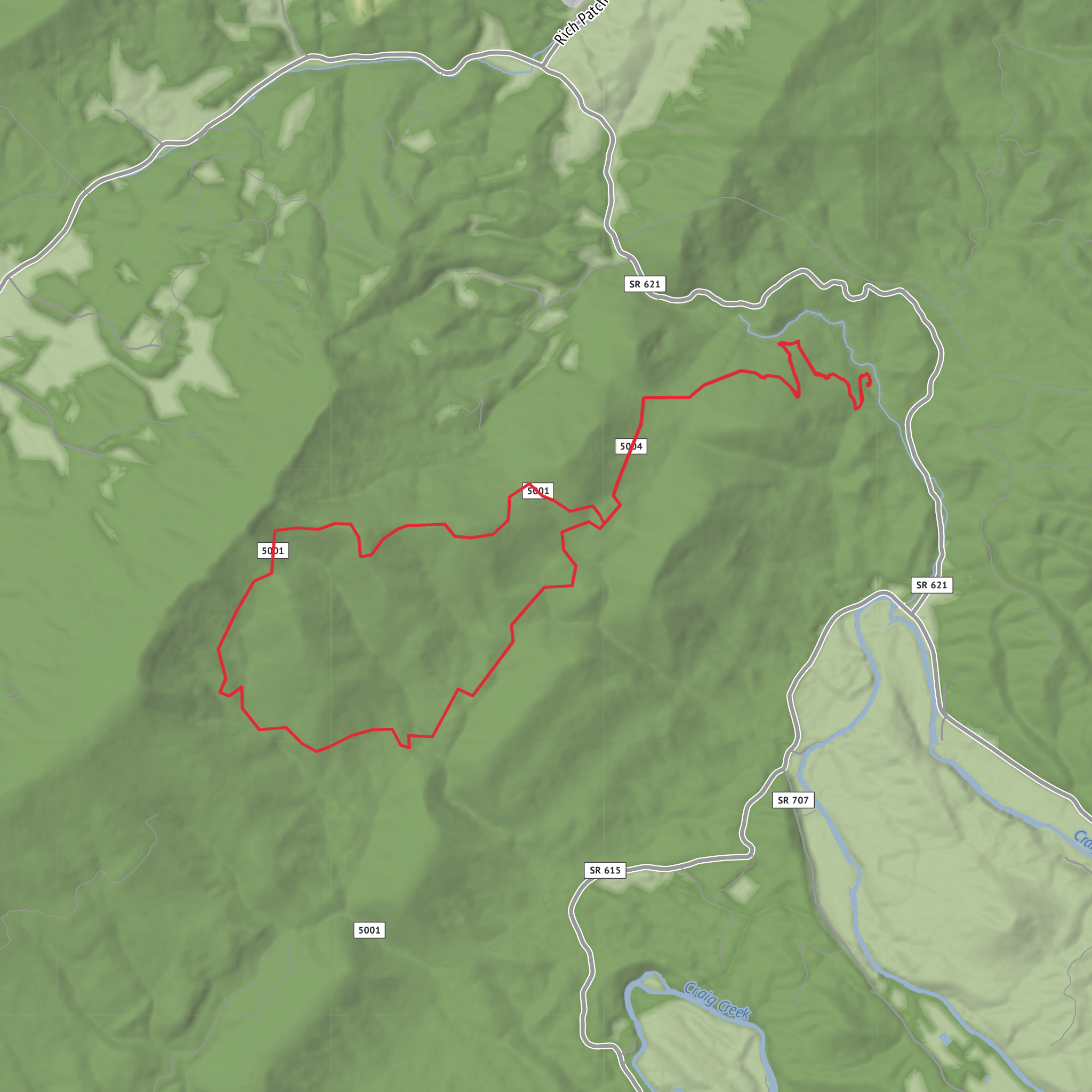
This loop is a rugged, ridge-and-hollow circuit in the George Washington & Jefferson National Forests near Eagle Rock, Virginia, linking the Iron Ore Trail (FT #5004) with the Hoop Hole National Recreation Trail (FT #5001). At around 17 km (10.6 mi) with roughly 800 m (2,625 ft) of climbing, it’s a steady “medium” day for fit hikers—expect sustained grades, rocky footing on the ridge, and a couple of creekside sections that can feel slow after rain.
Getting to the start (car + public transport)
Closest practical start point: the main parking for Roaring Run Day Use Area / Roaring Run Recreation Area, near Eagle Rock, VA (Botetourt County). The day-use area is the common jumping-off point for both the Iron Ore Trail connection and nearby Roaring Run trails. (fs.usda.gov)
By car: Navigate to Roaring Run Day Use Area (USFS) near Eagle Rock. You’ll drive the last short stretch on the entrance road into the day-use area and park at the trailhead lot. (fs.usda.gov)
Planning note: this is a developed day-use site, so it’s one of the easier trailheads in the area for parking and finding the correct start.By public transport: There isn’t reliable public transit directly to the Roaring Run Day Use Area. The closest realistic approach is to get to the Roanoke / Salem area (regional buses/Amtrak connections depending on your origin), then use a rideshare or taxi for the final rural leg to Eagle Rock and the trailhead. Build in extra buffer time—cell coverage can be inconsistent once you’re in the forested valleys.
If you’re using a navigation app, download the route for offline use in HiiKER before you arrive—this area has multiple junctions and it’s easy to follow the “right trail in the wrong direction” if you’re tired on the ridge.
What the hike feels like, section by section
0.0–3.9 km (0.0–2.4 mi): Iron Ore Trail climb and warm-up (moderate) From the Roaring Run side, the Iron Ore Trail is your connector into the Hoop Hole system. It’s generally a moderate grade, but it’s not a groomed park path—expect roots, embedded rock, and short steeper pitches that can spike your heart rate early. This segment is also your first hint of the area’s industrial past: the trail name reflects the iron-ore history tied to the Roaring Run corridor. (hikingtheappalachians.com)
3.9–9.5 km (2.4–5.9 mi): Hoop Hole ascent to Pine Mountain ridge (harder work, rockier footing) Once you transition onto the Hoop Hole National Recreation Trail, the character changes: longer climbs, more ridge-like terrain, and a drier, rockier tread. The Hoop Hole system is known for its two-loop/figure-eight style layout in places, so pay attention at intersections—this is where having the route line in HiiKER matters most. (hikingtheappalachians.com)
As you gain elevation, the forest often shifts toward oak and pine, including Table Mountain pine on drier slopes and ridges—an Appalachian ridge-top community adapted to thin soils and exposure. (en.wikipedia.org)
9.5–12.5 km (5.9–7.8 mi): Ridge travel and the “Hoop Hole” area (rolling, scenic, exposed in spots) This is the payoff section: rolling ridge walking with periodic openings and a more “mountain” feel than the lower creek corridor. Even without huge overlooks, the ridge can feel airy, especially in leaf-off season.
The name “Hoop Hole” is associated with this trail system and area; it’s designated as a National Recreation Trail and is widely used by hikers, trail runners, and mountain bikers—so expect to share the tread and listen for faster traffic on descents. (en.wikipedia.org)
12.5–17.0 km (7.8–10.6 mi): Long descent back toward Roaring Run (knee-testing, then gentler) The return leg typically drops you off the ridge and back into
Comments and Reviews
User comments, reviews and discussions about the Iron Ore Trail and Hoop Hole Loop, Virginia.
average rating out of 5
0 rating(s)
